Travel to Tuscany
Day 7 Siena (0 Km.)
Siena: Siena was one of the most important cities in medieval Europe, and its historic centre is a UNESCO World Heritage Site. We begin our tour of the city with a visit to the Basilica of San Francesco. The church was built in the 13th century and is known for its simple yet elegant Gothic architecture. The interior of the basilica features beautiful frescoes and works of art, including some by the famous Italian artist Duccio di Buoninsegna. One of the most notable features of the Basilica of San Francesco is the Chapel of Saint Catherine, which contains the relics of Saint Catherine of Siena, a patron saint of Italy who was born in Siena in the 14th century.
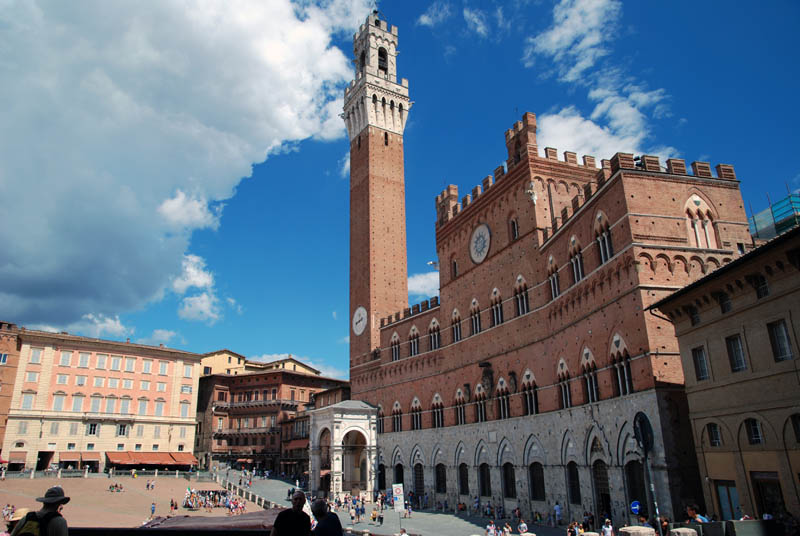
Siena - Palazzo Pubblico
The Palazzo Pubblico is a historic building located in the Piazza del Campo. It was built in the 13th century as the seat of the government of the Republic of Siena, and today it serves as the city hall. The palace is known for its beautiful Gothic architecture, including its iconic bell tower, the Torre del Mangia, a 14th-century bell tower. You can climb to the top of the tower for panoramic views of Siena and the surrounding countryside. The interior of the Palazzo Pubblico features many notable frescoes and works of art, including Ambrogio Lorenzetti's famous frescoes depicting good and bad government in the Sala dei Nove (or Council Room). The palace is open to visitors, who can explore its various rooms and learn more about the history of Siena and the Palazzo Pubblico.
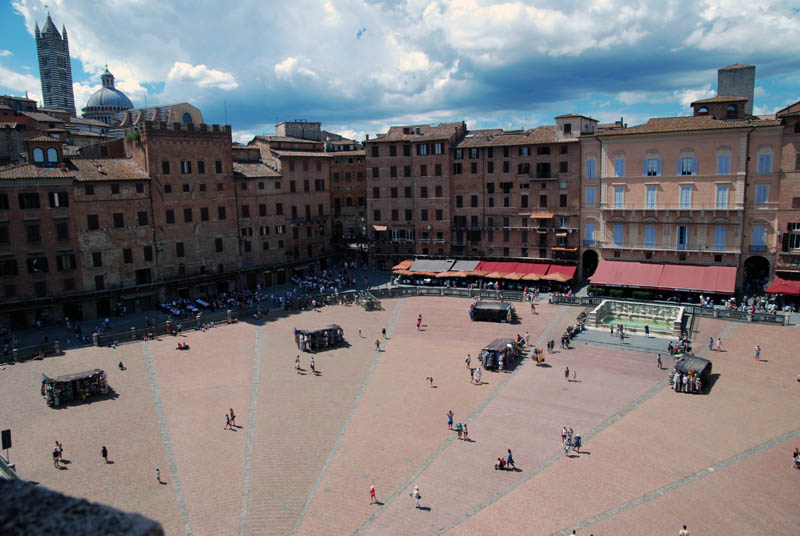
Siena - Piazza del Campo
The Piazza del Campo is the central square of the city of Siena. It is a large, shell-shaped plaza that is surrounded by historic buildings and is famous for its unique architecture and rich history. The Piazza del Campo is considered one of the most beautiful medieval squares in Europe and is a UNESCO World Heritage Site. It is also known for hosting the Palio di Siena, a twice-yearly horse race that dates back to the 17th century. Other sights of this square are Fonte Gaia, a beautiful fountain located in the center of the square. The original fountain was built in the 14th century, and the current one is a replica that was installed in the 19th century. Loggia della Mercanzia is a covered gallery that was originally built in the 14th century for merchants to display their goods. Other famous building of Piazza del Campo is the Palazzo Chigi-Saracini, a Gothic palace that is home to the Accademia Musicale Chigiana.
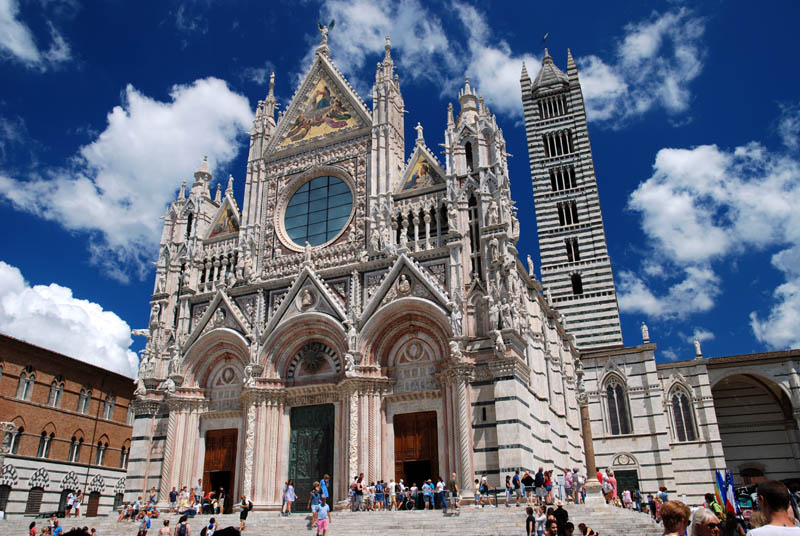
Siena - Cathedral (Duomo)
The Duomo at Siena, also known as the Siena Cathedral, was built between the 12th and 14th centuries and is dedicated to the Virgin Mary. It is a UNESCO World Heritage Site. The exterior of the Duomo is an impressive example of Italian Gothic, which is characterized by pointed arches, elaborate decoration, and a sense of height and verticality. The exterior is made of alternating bands of white and greenish-black marble, which create a striking striped effect. The front facade features intricate carvings and sculptures, including scenes from the Bible and figures of saints. Above the main entrance is a rose window with elaborate tracery and stained glass. The bell tower, which stands next to the cathedral, is a separate structure with a similar striped design. The right side of the cathedral has a large round window called the "Wheel of Fortune," which depicts the cycles of life and fate. The left side features a relief sculpture of the Massacre of the Innocents, a biblical story about King Herod ordering the killing of all male infants. At the back of the cathedral is a small entrance known as the "Gate of Heaven," which is decorated with colorful mosaics.
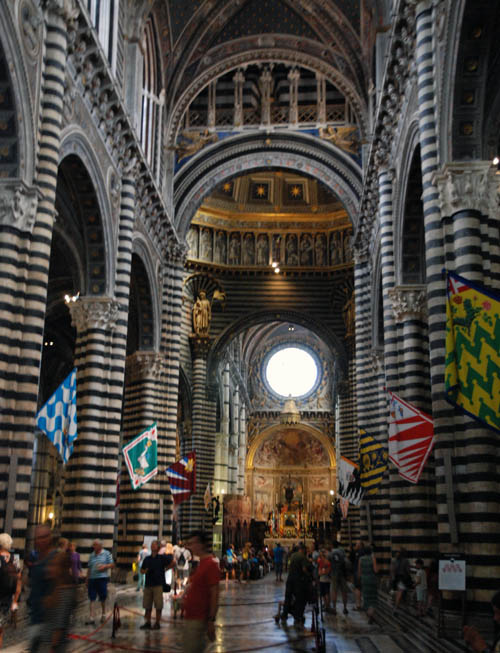
Siena - Duomo interior
In the interior the pictorial effect of the black and white marble stripes on the walls and columns strikes the eye. The nave of the cathedral is supported by a series of marble columns with ornate capitals, which create a sense of height and grandeur. The ceiling of the nave is painted with gold stars on a deep blue background, evoking the heavens above. The transept of the church is marked by a large octagonal dome, which is decorated with intricate patterns and frescoes. The interior of the Duomo is home to many important works of art, including frescoes by artists like Pinturicchio and Bernini. The apse of the church features a large mosaic of the Virgin Mary with child, surrounded by scenes from the life of Christ. The hexagonal dome is topped with Bernini's gilded lantern.
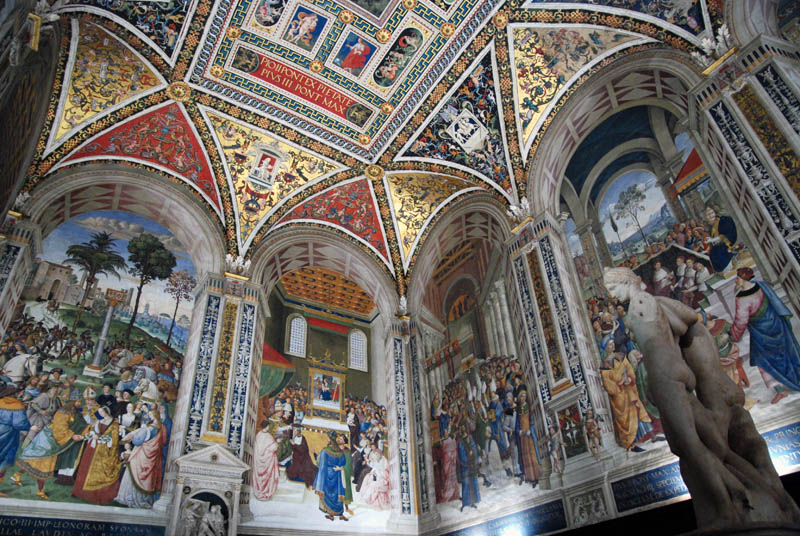
Siena - Duomo - Piccolomini Library
The Piccolomini Library, located in the south transept, was built in the late 15th century for Cardinal Francesco Todeschini Piccolomini, who later became Pope Pius III. It is adorned with beautifoul frescoes by Pinturicchio that depict scenes from the life of Pope Pius II. The frescoes are known for their vibrant colors and intricate details, which include depictions of animals, landscapes, and architectural elements. The Piccolomini Library as commissioned by Todeschini Piccolomini in the 15th century as a repository for his extensive collection of books and manuscripts. The library also contains a number of important manuscripts and books, including works by Cicero, Virgil, and other ancient Roman authors. The ceiling of the library is decorated with gold stars on a deep blue background, creating a celestial effect. The Chapel of the Madonna di Vitaleta, located in the north transept, contains a beautiful statue of the Madonna and Child. The floor of the Duomo is made up of more than 50 inlaid marble panels that depict biblical scenes and allegories. The pulpit, located near the entrance to the nave, is a masterpiece of Gothic sculpture, with reliefs that depict scenes from the life of Christ.

Siena - Duomo - Baptistry
The Battistero di San Giovanni, or the Baptistry of St. John, is a beautiful medieval baptistry located in the Piazza del Duomo, next to the Siena Cathedral. The baptistry was built in the 14th century and is considered one of the finest examples of Italian Gothic architecture. The exterior is adorned with intricate carvings and beautiful marble decorations. In the interior, the rectangular hall, divided into a nave and two aisles by two columns, contains a hexagonal baptismal font in bronze, marble and vitreous enamel, realized in 1417-1431 by the main sculptors of the time: Donatello, Lorenzo Ghiberti, Giovanni di Turino, Goro di Neroccio and Jacopo della Quercia. The panels represent the Life of John the Baptist. The marble shrine on the font was designed by Jacopo della Quercia between 1427 and 1429. The five "Prophets" in the niches and the marble statuette of "John the Baptist" at the top are equally by his hand. Two of the bronze angels are by Donatello and three by Giovanni di Turino.

Siena - Palazzo Salimbeni
After visiting the Basilica of San Domenico, we finished the route by seeing the façades of two remarkable palaces. The Palazzo Salimbeni, located in a piazza of the same name, was the original headquarters and remains in possession of the Monte dei Paschi di Siena, one of the oldest banks in continuous existence in Europe. The building was originally constructed in the 14th century. Over the centuries, the palace was expanded and renovated several times, resulting in a unique blend of architectural styles ranging from Gothic to Renaissance. Walking through Via Banchi di Sopra, we reached the Piazza Tolomei, where we saw the Palazzo Tolomei. The Tolomei Palace, which dates back to the 13th century, dominates the eastern side of the square. The palace features a mix of architectural styles, including Gothic and Renaissance, and is known for its beautiful façade and interior courtyard. The square is also home to several other notable buildings, including the Church of Saint Christopher and a column on which the Capitoline Wolf is placed feeding the Romulus and Remus.