Travel to Budapest
Day 1 Castle hill
Between the Fishermen´s Bastion and the Matthias Church is the Szentháromság tér square, where the bronze equestrian statue of King Stephen I (Szent István szobra), founder of Hungary, stands out. Next we visit the Matthias Church. The temple was built during the reign of Béla IV, in the thirteenth century. After 1541, when the city of Buda was invaded by the armies of the Ottoman Turks, the church of Our Lady was transformed into a mosque, only to recover its situation almost 150 years later when the Germanic armies regained the kingdom.

Budapest - Bastion of the fishermen and Matthias church
The church acquired its current form during the restoration of the late nineteenth century. Thanks to its excellent acoustics, organ and classical music concerts are also held inside. His fresco paintings and stained glass windows are due to the greatest artists of the time (Bertalan Székely, Károly Lotz). On the outside, the colors of the glazed tiles that cover the ceiling stand out. It is one of the most beautiful temples of eclectic architecture in Hungary and is in the vicinity of the statue of the Holy Trinity, built to commemorate the epidemic of 1709.

Budapest - Matthias church
In the middle of the Trinity square (Szentháromság tér) we found the column that conmemorates the people who died during the plagues of 1691 and 1709. On the top of the column we can see a stone carved statue from 1706 representing the Holy Trinity. After passing in front of the wine museum, we move through one of the streets of the castle district, until we reach the corner where are located the Lutheran church and the Vienna Gate (Bécsi Kapu), one of the entrances of the wall rebuilt in 1936. Next to the door stands the imposing neo-Roman style building that houses the National Archive of Historical Documents.
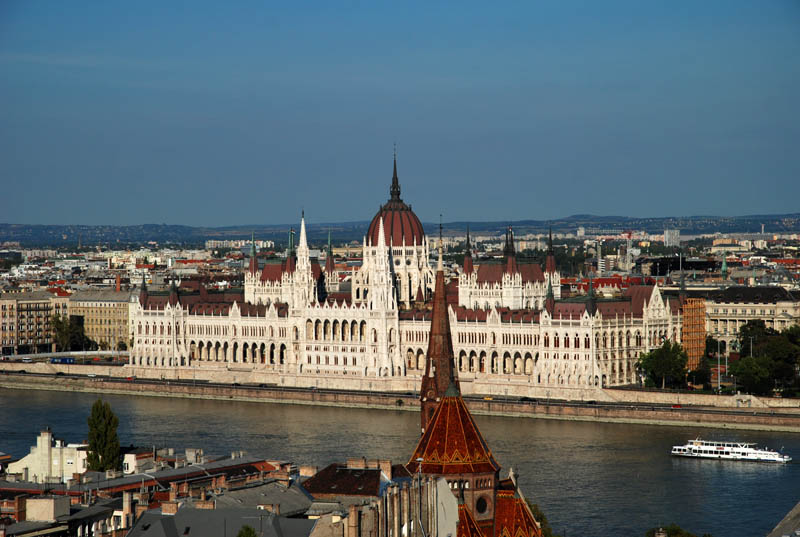
Budapest - Views of the Hungarian Parliament
In the square Kapisztrán tér we find the Franciscan Church of Saint Mary Magdalene (Mária Magdolna Torony), built in the mid-thirteenth century in Gothic style and now in ruins. Due to the damage suffered by an air attack at the end of the Second World War it was decided during the 1950s to demolish all the construction, except the tower and the portal, visible from the garden, together with a window of the presbytery reconstructed in Gothic style.

Budapest - Lord´s street (Úri utca)
We return by the gentleman street (Úri utca) in which the facades of many of its buildings stand out. This street in which the aristocracy lived was destroyed in 1686 and also at the end of the Second World War, being rebuilt in the 1950s, with baroque or neoclassical facades, some of them adorned with noble coats of arms. In the middle of the street we find a small square with the equestrian statue of Andreas Hadik. One of the houses houses the German embassy, while in another one we find the Telephone Museum (Múzeum Telephone).
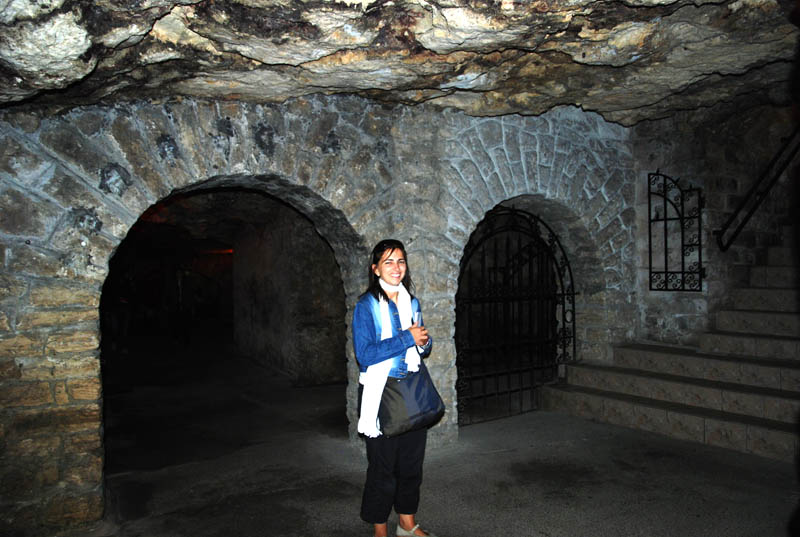
Budapest -Buda castle labyrinth
The entrance to the Labyrinth of Buda Castle is located at number 9 on Uri utca street. It is a series of underground galleries and caves with a total length of more than 1200 meters. Already used in prehistory, it has had different uses such as winery, bomb shelters, prison, etc. Reading comments from different travelers, these consider this visit as dispensable. Leaving the labyrinth, we watched from the Fishermen's Bastion as the last rays of the sun illuminated the facade of the parliament building and the lights began to illuminate the city.