Travel to Budapest
Day 3 Buda Castle, Margaret Island
We returned to the castle hill to walk around the Buda Castle, which we could not access on the first day. The Buda Castle or Palace is the historical residence of the Hungarian kings in Budapest. In the past it was also called the Royal Palace. It was built in Late Gothic style during the 14th century, but it was completely rebuilt in the mid-18th century (1748-1769) in late-Baroque style. The current extension of the building dates, however, from the second half of the 19th century when its surface was duplicated in a pompous neo-baroque style. The resulting castle became one of the most extensive and monumental royal residences in Europe.
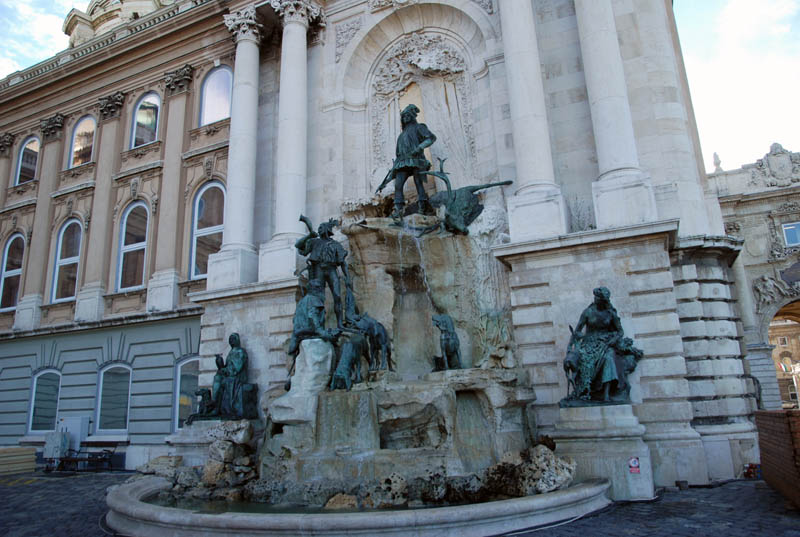
Budapest - Matthias Fountain
Buda Castle is part of the Budapest World Heritage Site, declared in 1987. As a result of its dominant position over the city, the Royal Castle was seriously damaged during the Siege of Budapest at the end of World War II. Taking advantage of its semi-dilapidated state, the new Hungarian communist government began the reconstruction of the building in a severe neoclassical style. The exuberant decorations and the diverse references to the Habsburg monarchy were eliminated. Inside, the old royal apartments gave way to large exhibition halls. Various institutions settled in the old castle such as the Hungarian National Gallery or the Budapest History Museum.

Budapest - Buda Castle
In the western part of the palace we can see the Matthias Fountain (Mátyás kútja), a neo-baroque masterpiece by Alajos Stróbl and one of the most photographed places in the Hungarian capital. It is sometimes called the "Trevi Fountain of Budapest". The fountain was erected by the sculptors Alajos Stróbl and Alajos Hauszmann, master builders of the reconstruction of the Royal Palace. After the composition scheme was approved by King Franz Joseph, Stróbl began to work in 1899. The fountain was inaugurated in the presence of the king in 1904. Next to the east facade we find the equestrian statue of Duke Prince Eugene of Savoy, liberator of Buda in 1686, and the fountain of the Fishing Children by Károly Senyei.

Budapest - Church of St. Anne
We went down from the castle hill and, on the way to the Margaret island, we stopped, next to the Danube, in the church of St Anne (Felsővízivárosi Szent Anna-plébánia és templom), a Roman Catholic church built by the Jesuits between 1740 and 1762 , and one of the most beautiful baroque buildings in Budapest. We could not visit it because it only opened during the services, but through its glass door we could see the 20th century frescoes inside, along with the altar and the golden pulpit of Charles Bebo decorated with white angels. On the exterior, its two 52-meter high towers stand out on the façade.

Budapest - Margaret Island´s water tower
We enter to the Margaret island by the bridge of "Margit híd". The Margaret island is an island of 2.5 km long located in the middle of the Danube. A short distance away we find one of its first attractions: the Music Fountain (TheMusic Fountain and the Water Tower are monuments protected by Unesco.) And the Centennial Memorial of the city's unification. A little further on, next to the main road, we find the ruins of the church of the Franciscan monastery, founded around 1270. In the next section we have on the right the Rose Garden and on the left a water park and the Hajós Alfréd Sports Pool. Our next visit is the ruins of the Dominican convent where Princess Margaret (to whom the island owes its name) spent her life.

Budapest - Margaret Island´s Japanese Gardens
Just 100 meters away, we find the famous octagonal water tower, 57 meters high, modernist construction from 1911, which today is used as a lookout and an exhibition hall. A few steps we see the Chapel of St. Michael, a reconstruction of the temple of the twelfth century made in 1932. After crossing a long meadow we reach the Japanese garden, with a small waterfall that falls into a pond in the middle of which we find the statue called " The thirsty woman. " We ended the visit to the island in the "Music Well" (Zenélő kút), a small pavilion that was originally built for outdoor concerts, very close to the "Árpád hid" bridge, the other point of entry to the island.