Travel to Budapest
Day 2 Lipótváros
We started our second day of visits by the Lipótváros neighborhood, specifically at Liberty Square (Szabadság tér), a public square that is a mix of business and residential. The United States Embassy in Hungary and the historicist style headquarters of the Hungarian National Bank abut the west side of the square. Some buildings on the square are designed in the Art Nouveau style. Ignác Alpár designed two of the buildings. The square houses monuments to Ronald Reagan and Harry Hill Bandholtz and a monument to the Soviet liberation of Hungary in World War II from Nazi German occupation. It was designed by Károly Antal.

Budapest - Liberty square
At number 4 on Hold utca Street we find the building of the Old Postal Savings Bank Office (Posta Takarékpénztár), built in 1901 in Art Nouveau style on the plans of Ödön Lechner and Sándor Baumgarten. It has floral motifs from Hungary, colorful tiles and majestic ceramics. The octagonal columns stand out on the façade, topped by Indian motifs and ceramic decorations and tiles on the roof. As a savings bank, the gable is decorated with golden bees, symbol of collection and savings. Inside, the glass dome surprises.

Budapest - Former Post office savings bank
The Basilica of St. Stephen (Szent István-bazilika) is the cathedral of Budapest. Together with the Parliament of Budapest, it is the tallest building in the city (with 96 m), in addition is the largest religious building in the country, with a capacity for 8,500 people. It began to be built around the year 1851, ending 54 years later, in the year 1905. It was built under the canons of the Neoclassical style, with a Greek cross plan, 87 m long and 55 m wide. The main facade is completed with two twin towers as bell towers. From the dome you get excellent panoramic views of Budapest; It is accessed at the top by elevators or by 364 steps.
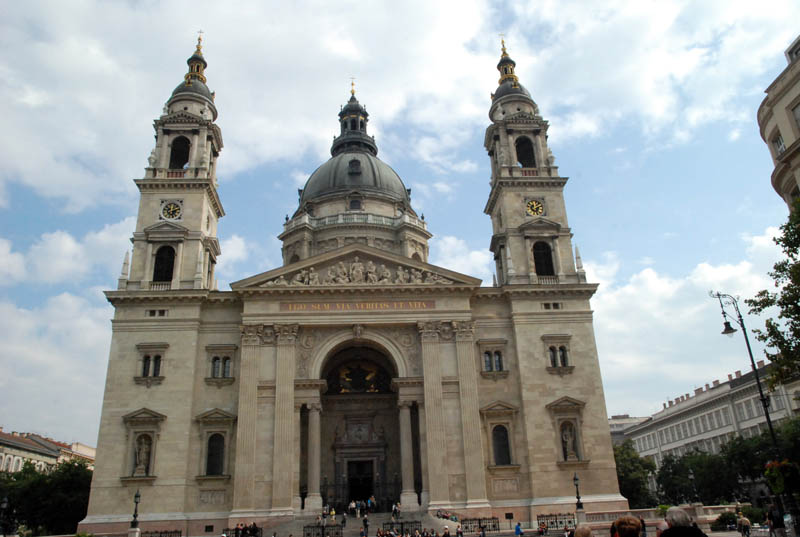
Budapest - St. Stephen´s Basilica
In the chapel located behind the apse, the most important relic of Hungarian Christianity is preserved: Saint Diestra, that is, the mummified hand of King Stephen I, first king of Hungary and saint. The basilica has a sumptuous decoration inside, with paintings, marbles and jasper plaques, reliefs and sculptures, completed throughout the nineteenth and twentieth centuries. Among the works of art, stand out the statues of Alajos Stróbl and the painting of Gyula Benczúr, St. Stephen asks for the protection of the Virgin for the country. Thanks to its acoustics, inside you can enjoy organ concerts.

Budapest - Dome of St. Stephen´s Basilica
On the banks of the Danube, in the Roosevelt tér square, we find another of the emblematic buildings of Lipótváros. This is the Hungarian Academy of Sciences (Magyar Tudományos Akadémia), whose central building was inaugurated in 1865 in neo-Renaissance style. Its façade features six statues representing six of its eleven main disciplines of knowledge. Although it was not possible to visit, we could go up the stairs to its first floor and through a large window see the impressive classicist statues resting on the columns of the Academy's auditorium.

Budapest - Hungarian Academy of Sciences
The Gresham Palace is another of the outstanding buildings of Budapest. Completed in 1906 as an office and apartment building, it currently houses the Four Seasons Hotel Budapest Gresham Palace. It is located next to the Danube River, in front of the Chain Bridge. The Gresham Palace is an example of the Viennese Art Noveau style, which stands out by the large windows and the pilasters located along the facade of the building. The palace also presents beautiful works in wrought iron, including two magnificent turkeys in the patio door, which are typical of Art Nouveau ornamentation.

Budapest - Gresham palace
After spending the whole morning touring this neighborhood, we made a break to eat, taking advantage of the abundant offer of restaurants in this area. After crossing the lively squares of Erzsébet téri park and Deák Ferenc tér we arrive to the outskirts of the Jewish quarter of Budapest.