Travel to Netherlands
Day 6 Driebergen - The Hague - Delft - Rotterdam (104 Km.)
(in 75 Km.) The Hague: The city of The Hague, or Den Haag in Dutch, has its origins in the 13th century when Count Floris IV of Holland built a hunting lodge on the site that would later become the Binnenhof. Although it never received official city rights, The Hague developed as the administrative center of the Netherlands. It has long been the seat of the Dutch government, parliament, the Supreme Court, and the Council of State, despite not being the capital. Throughout the centuries, The Hague grew into an important political and diplomatic hub, housing embassies and international institutions such as the International Court of Justice and the International Criminal Court. The presence of royal palaces and ministries further established its role as the political heart of the country. The historic city center blends medieval origins with 19th-century government buildings and modern developments.
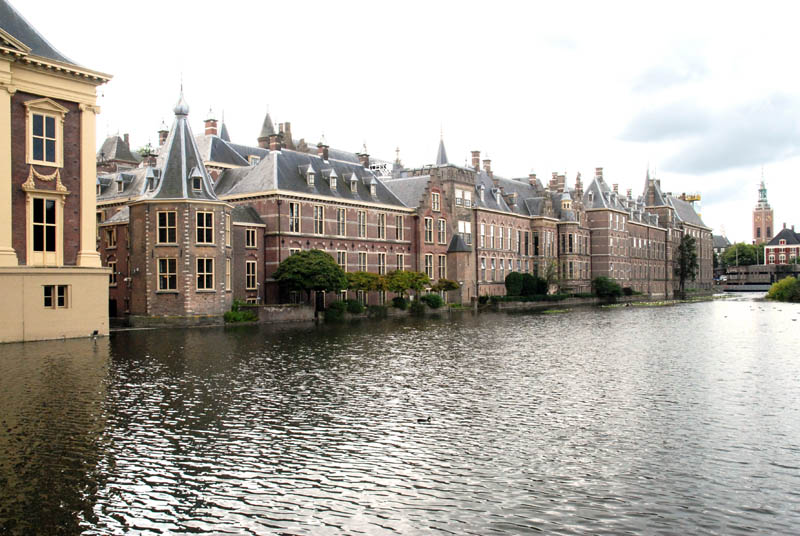
The Hague - Binnenhof
We started our visit at the P+R Voorburg 't Loo RandstadRail Station and rode our bicycles toward the city center. Our first major stop was Mauritshuis, an art museum housed in a 17th-century palace, which contains a collection of Dutch Golden Age paintings including works by Vermeer, Rembrandt, and Frans Hals. Adjacent to it is the Binnenhof, a complex of buildings that has served as the center of Dutch politics for centuries. The buildings form a courtyard around the Hofvijver lake, with the Ridderzaal or Hall of Knights at its heart. Although the Ridderzaal was closed for renovations during our visit, we were able to view the exterior and the surrounding Gothic architecture. We continued cycling around the Binnenhof area and then made a stop at the nearby Plein, a square bordered by cafes and administrative buildings, including the Ministry of Justice and Security.

The Hague - Noordeinde Palace
Next, we visited De Passage, the Netherlands’ oldest covered shopping arcade, which dates back to the late 19th century. The gallery features a glass-roofed corridor lined with shops, bookstores, and boutiques. After passing through the arcade, we cycled to Noordeinde Palace, located along Noordeinde Street. This working palace is one of the three official palaces of the Dutch royal family. Though not open to the public, we were able to view the exterior façade and the square in front, which includes a statue of King William I. From there, we continued toward the Grote Markt, a central area known for its restaurants and outdoor seating. We stopped here for lunch, making use of the nearby bicycle parking facilities, before continuing our walk in the surrounding streets.

The Hague - Grote of Sint-Jacobskerk
Before ending our route, we visited Grote of Sint-Jacobskerk, also known as the Great Church of The Hague. This six-sided tower structure is one of the city’s oldest buildings, dating back to the 14th century. Historically used for royal baptisms and other ceremonial events, the church is no longer used for regular services but is accessible for special occasions and events. We walked around the perimeter and observed the architectural details, including the stained-glass windows and the medieval stonework. After a brief rest in a nearby square, we returned to our bicycles and rode back to the P+R Voorburg 't Loo, completing our route through The Hague.
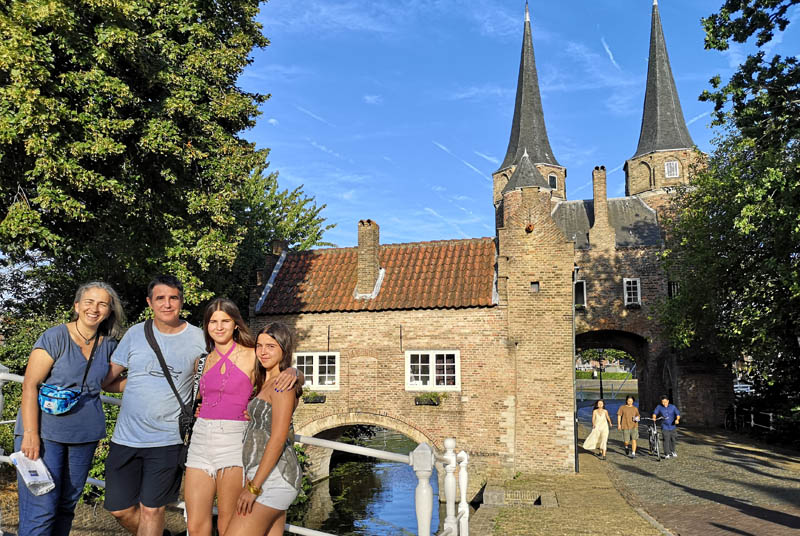
Delft - Oostpoort
(in 13 Km.) Delft: Delft is a historic city in the province of South Holland, founded around the 11th century and officially granted city rights in 1246. The name “Delft” comes from the word “delven,” meaning “to dig,” referring to the canals that were excavated to manage water and trade. In the 16th and 17th centuries, Delft became an important center for the Dutch East India Company and the production of Delftware, the city’s iconic blue and white ceramics. It also played a significant role in Dutch political history; William of Orange, the founding father of the Netherlands, lived in Delft and was assassinated there in 1584. Over the centuries, the city developed into a cultural and educational center, notably housing the Delft University of Technology. Despite a major fire in 1536 and a gunpowder explosion in 1654, many historic buildings were preserved or rebuilt, giving the city its current architectural character.

Delft - Markt square and Nieuwe Kerk (New Church)
We started our walking tour at Oostpoort, the eastern gate of the medieval city, which remains the only surviving city gate. Built around 1400, the Oostpoort consists of twin towers and a drawbridge, and marks the entrance to the old town. From there, we followed the streets toward the Markt, the main market square of Delft. This large open plaza is paved with cobblestones and is surrounded by historic buildings, shops, and restaurants. At the eastern side of the square stands the Nieuwe Kerk (New Church), a Gothic-style Protestant church completed in the 15th century. It is notable for its tall tower and for housing the royal crypt of the Dutch royal family, where members of the House of Orange-Nassau are interred. The tower is one of the tallest in the Netherlands.

Delft - Stadhuis (City hall)
Facing the Nieuwe Kerk across the market square is the Stadhuis, or City Hall, a Renaissance-style building dating back to the early 17th century. The current façade was designed by architect Hendrick de Keyser after the original Gothic structure was destroyed by fire. We viewed the building from the exterior, observing the red shutters and sculpted stonework. Afterward, we continued walking to the Oude Kerk (Old Church), located a short distance from the market square. The church dates back to the 13th century and is characterized by its leaning brick tower. Inside are the tombs of several prominent Dutch figures, including the painter Johannes Vermeer and scientist Antoni van Leeuwenhoek. The church stands next to a canal, with its tower reflected in the water.

Delft - Oude Kerk (Old Church) and Oude Delft canal
We continued walking along the Oude Delft, one of the oldest canals in the city. This canal runs north to south through the historic center and is lined with houses, bridges, and small moorings. Walking along its banks gave us a view of several period buildings with stepped gables and canal-facing façades. Our next stop was Molen de Roos, the only remaining windmill inside the city center. Originally one of several mills in Delft, De Roos is still operational and sometimes used to grind grain. We observed the windmill from the street and took note of its round base and sails. A footpath nearby allowed us to see the surrounding structures and residential areas.

Delft - Molen de Roos
To conclude our visit, we passed by the Prinsenhof, a former monastery that later became the residence of William of Orange. It is now a museum that covers the Eighty Years’ War and the early history of the Dutch Republic. Although we did not enter, we viewed the building from the courtyard, where a plaque marks the spot where William was assassinated. The bullet holes in the wall are still visible. After walking through the gardens and viewing the exterior architecture, we made our way back through the city center, ending our walking tour of Delft.
(in 16 Km.) Rotterdam: We arrived in this city where we will sleep for a couple of nights.