Travel to Singapore
Day 3 Arab Quarter
After lunch at City Square Mall, we travelled by MRT to the historic Arab Quarter, also known as Kampong Glam. This district was designated by Sir Stamford Raffles in 1822 as the area where the Malay, Arab, and Muslim communities would settle. During the nineteenth century, merchants from Yemen, Indonesia, Malaysia, and other parts of the Malay Archipelago established businesses here, trading textiles, spices, carpets, perfumes, and other imported goods. Kampong Glam also became the residence of the Sultan of Johor and his court, giving the district both commercial and political importance during Singapore's early colonial period. Today, many of its historic streets and shophouses have been carefully preserved, combining traditional businesses with cafés, boutiques, restaurants, galleries, and cultural institutions. We explored the neighbourhood entirely on foot, following a route through its principal streets and landmarks.
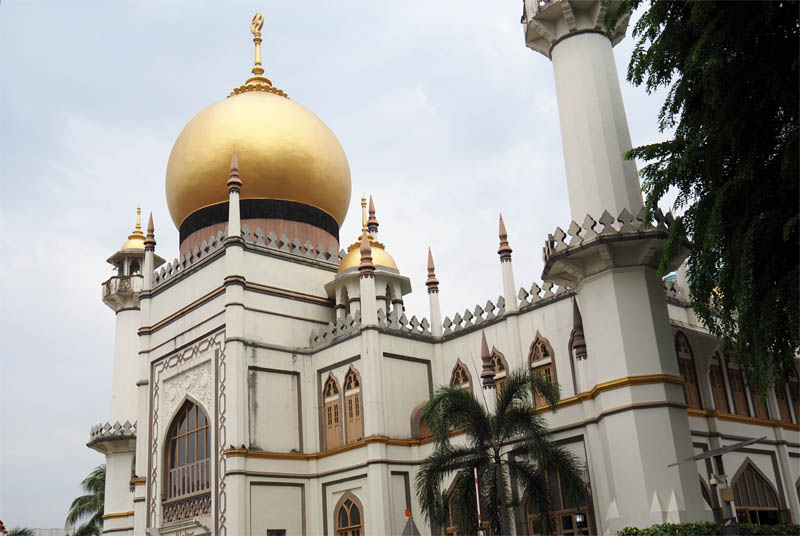
Singapore - Sultan Mosque
Our first destination was the Sultan Mosque (Masjid Sultan), the most important mosque in Singapore and the symbolic centre of Kampong Glam. Completed in its present form in 1932, the mosque replaced an earlier building commissioned by Sultan Hussein Shah shortly after the British established Singapore. Its architecture combines Islamic, Indian, and European influences, while its large golden dome dominates the surrounding skyline. Around the base of each dome are decorative glass bottle ends, incorporated into the design so that members of the community could contribute to the construction regardless of their financial means. We arrived shortly after visiting hours had ended, so we were only able to admire the exterior. From the square in front of the mosque, we observed its symmetrical façade, tall minarets, and the wide staircase leading to the main entrance, while information panels explained its historical significance within Singapore's Muslim community.
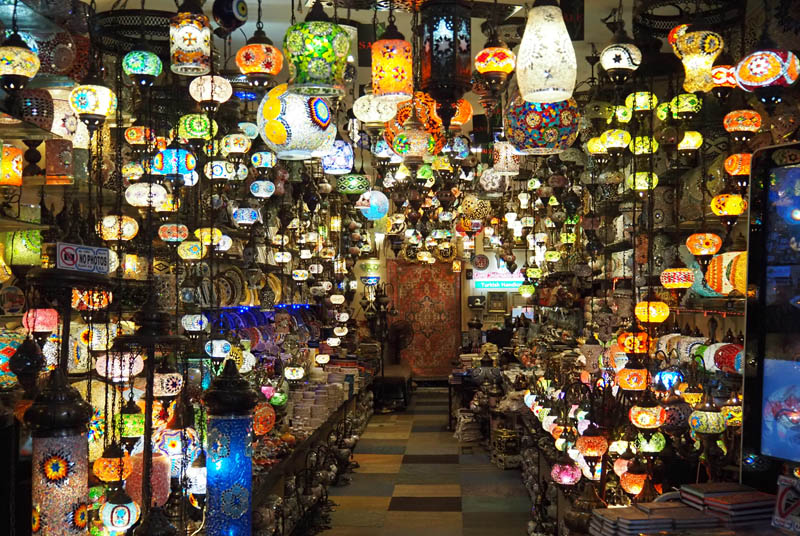
Singapore - Turkish lamps at Arab Street
From the mosque, we continued along Arab Street, historically one of Singapore's principal commercial streets for merchants trading with the Middle East and the Malay world. Many of the restored nineteenth-century shophouses continue to accommodate businesses specialising in fabrics, silk, carpets, batik textiles, perfumes, handicrafts, and traditional clothing. Several shops display colourful rolls of cloth and handmade decorative items, reflecting the area's long-standing association with the textile trade. The buildings preserve their original architectural features, including timber shutters, decorative plasterwork, ceramic tiles, and the characteristic covered walkways known as five-foot ways. As we walked through the district, we also passed numerous cafés and restaurants occupying the ground floors of these historic buildings. The combination of preserved commercial architecture and traditional businesses illustrates the important role Arab Street has played in Singapore's trading history for more than a century.
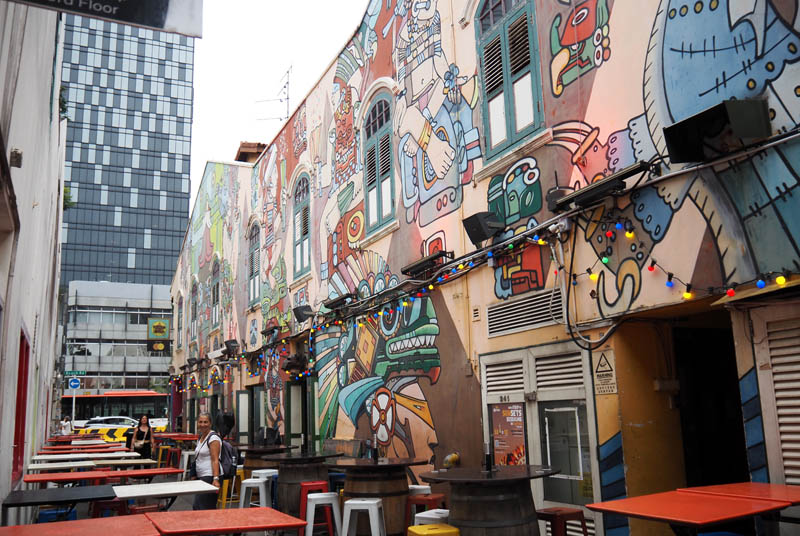
Singapore - Haji Lane
Our route then led us into Haji Lane, one of the narrowest streets in Singapore and today one of the best-known pedestrian lanes in Kampong Glam. Originally built as a residential and commercial street for pilgrims preparing to travel to Mecca, it has gradually evolved into a centre for independent shops, cafés, fashion boutiques, and creative businesses. The restored shophouses lining both sides of the lane retain their historic structure while housing contemporary businesses. Haji Lane is also recognised for its extensive collection of street art, with many building façades covered by large murals created by local and international artists. The artworks include portraits, abstract compositions, geometric designs, floral themes, and cultural references reflecting Singapore's multicultural identity. We spent some time walking through the surrounding streets to observe the different murals, many of which occupy entire building façades and have become a distinctive feature of the neighbourhood.
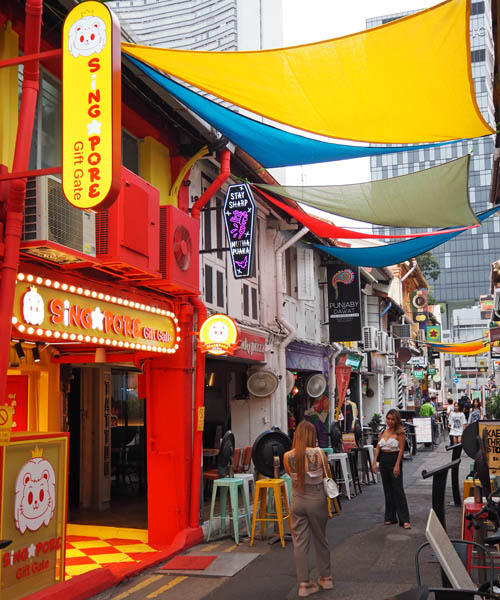
Singapore - Haji Lane
Before leaving Kampong Glam, we walked to nearby Parkview Square, often referred to simply as the Parkview Building. Completed in 2002, this 24-story office building is widely recognized for its distinctive Art Deco-inspired architecture, which is somewhat unusual in Singapore’s predominantly contemporary cityscape. Its monumental granite facade, bronze details, sculptural decorations, and symmetrical design have earned it the nickname "Gotham Building," due to its resemblance to the architecture featured in the Batman movies. Although the interior is best known for housing the Atlas Bar, with its impressive collection of liquors and richly decorated lobby, we limited our visit to viewing the exterior from the surrounding streets. We concluded our exploration of Kampong Glam and moved on to the next leg of our visit to Singapore: the Esplanade area.