Travel to Singapore
Day 4 Gardens by the Bay
Our return journey included an evening stopover in Singapore, giving us the opportunity to revisit several places that we had not fully explored during our first stay. After arriving at Changi Airport, we travelled by MRT directly to Chinatown, where we began the visit in familiar surroundings. We returned to Hawker Chan, internationally known for becoming the world's least expensive restaurant to receive a Michelin star. The restaurant's signature soy sauce chicken with rice remains its best-known dish, prepared according to the original Cantonese recipe developed by founder Chan Hon Meng. After lunch, we decided to try one of Southeast Asia's most distinctive fruits: the durian. Easily recognised by its large, thorn-covered shell, the fruit is famous for its powerful aroma, which has led to its prohibition in many hotels and on Singapore's public transport system. Despite its controversial smell, durian is widely considered a delicacy throughout the region and is sold fresh in numerous markets across the city.
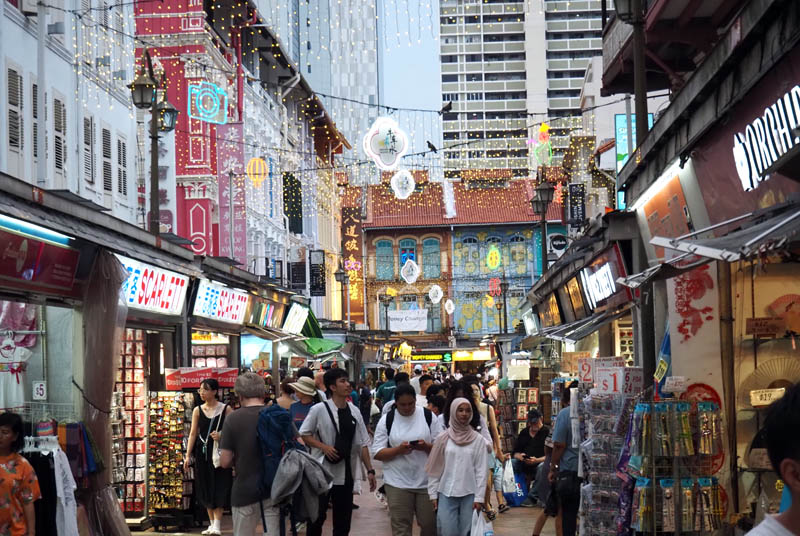
Singapore - Pagoda street
After leaving Chinatown, we boarded the MRT once again and travelled to Bayfront Station, located directly beneath Marina Bay Sands. From there, underground passages and pedestrian walkways provide direct access to Gardens by the Bay, one of Singapore's most ambitious urban landscaping projects. Opened in 2012, the gardens occupy approximately 101 hectares of reclaimed land and were created as part of the government's vision of transforming Singapore into a "City in a Garden". The site is divided into three main waterfront gardens: Bay South Garden, Bay East Garden, and Bay Central Garden, with Bay South being the largest and most visited section. The gardens combine botanical collections, sustainable architecture, recreational areas, lakes, and public art while showcasing plant species from around the world. Although we had already crossed the area on previous evenings, this visit allowed us to explore it in greater detail before the nightly performances began.
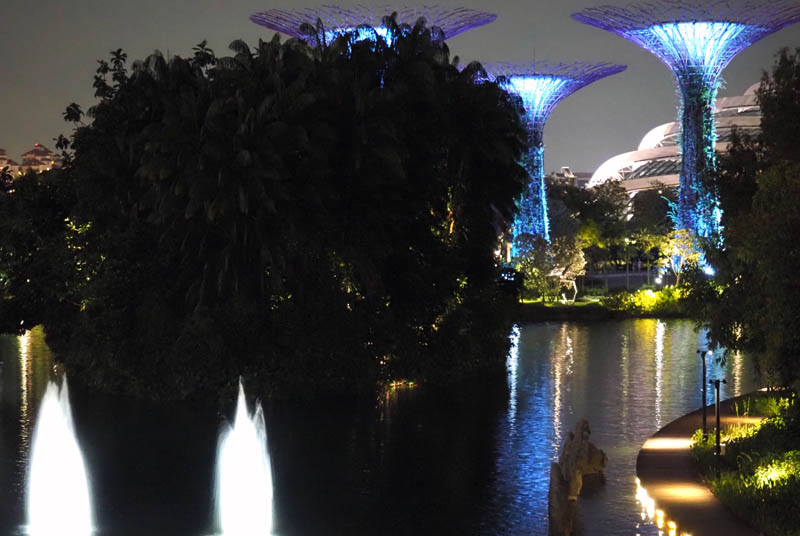
Singapore -Dragonfly Lake
Walking through Bay South Garden, we passed several of the park's principal attractions. The two large climate-controlled conservatories, Flower Dome and Cloud Forest, stand beside Dragonfly Lake and are among the largest glass greenhouses in the world. The Flower Dome recreates the climate of Mediterranean and semi-arid regions, displaying seasonal floral exhibitions and plant species from five continents. Nearby, the Cloud Forest houses a cool mountain environment centred around one of the world's tallest indoor waterfalls, with elevated walkways leading through vegetation typical of tropical highlands. We also passed the Dragonfly & Kingfisher Lakes, designed as natural ecosystems that contribute to water purification and biodiversity within the gardens. Throughout the park, information panels explain the sustainable technologies incorporated into the development, including rainwater collection, energy-efficient cooling systems, and the integration of ecological habitats within an urban environment.
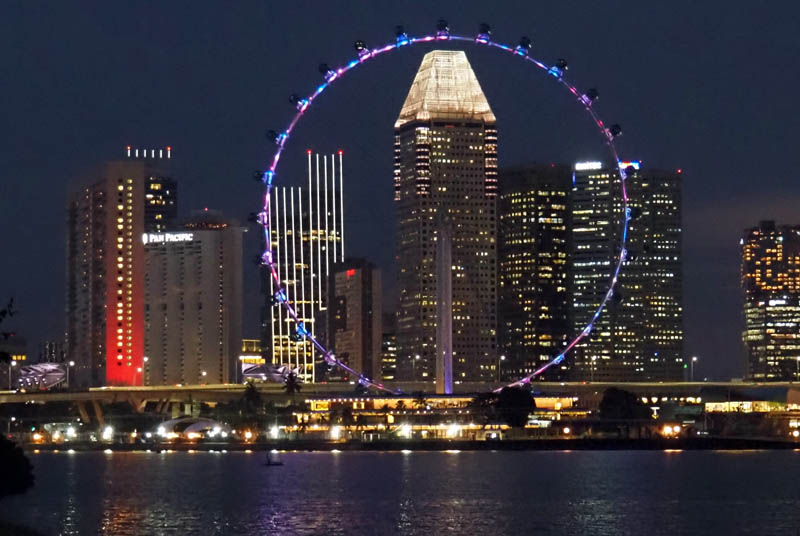
Singapore Flyer by night
The most distinctive features of the gardens are the Supertrees, a collection of vertical structures ranging between 25 and 50 metres in height. Eighteen Supertrees are distributed throughout Bay South Garden, functioning as both architectural landmarks and environmental infrastructure. Their steel frameworks support thousands of living plants, including orchids, bromeliads, ferns, and climbing species collected from tropical regions around the world. Several of the Supertrees also perform practical environmental functions by collecting rainwater, generating solar energy through photovoltaic panels, and acting as ventilation exhaust towers for the nearby conservatories. The tallest structures are connected by the OCBC Skyway, an elevated walkway suspended approximately 22 metres above the ground, offering visitors a different perspective over the gardens. Even from ground level, the Supertrees dominate the surrounding landscape and form the visual centrepiece of Gardens by the Bay.
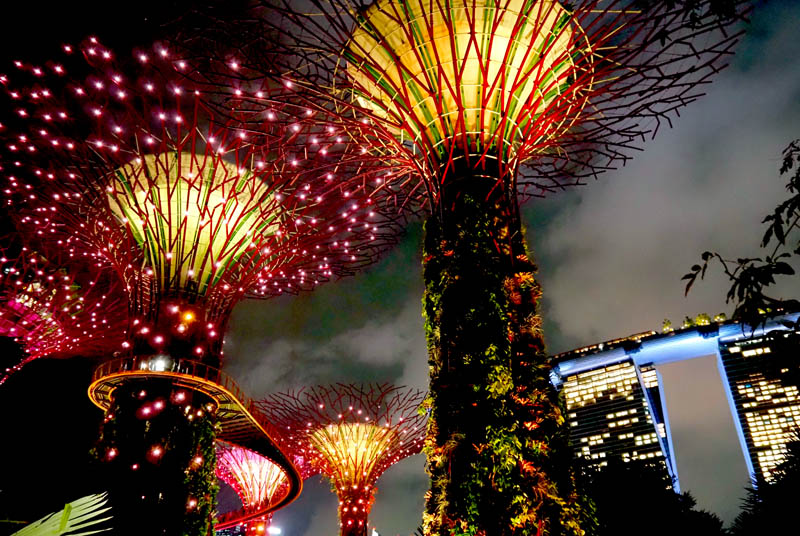
Singapore - Gardens by the Bay
As darkness fell, we joined the many visitors gathering beneath the Supertrees for the Garden Rhapsody light and sound show. This free performance takes place every evening, with synchronised music and changing coloured lights transforming the illuminated structures into a coordinated visual display. Since this was already our third visit to the nightly performance, we were familiar with the layout of the garden and selected a position beneath the central grove before the show began. During the performance, the lighting sequences travel between the different Supertrees while carefully programmed music accompanies the visual effects. The combination of lighting technology and the gardens' distinctive architecture has made Garden Rhapsody one of Singapore's best-known evening attractions and an integral part of the visitor experience at Gardens by the Bay.
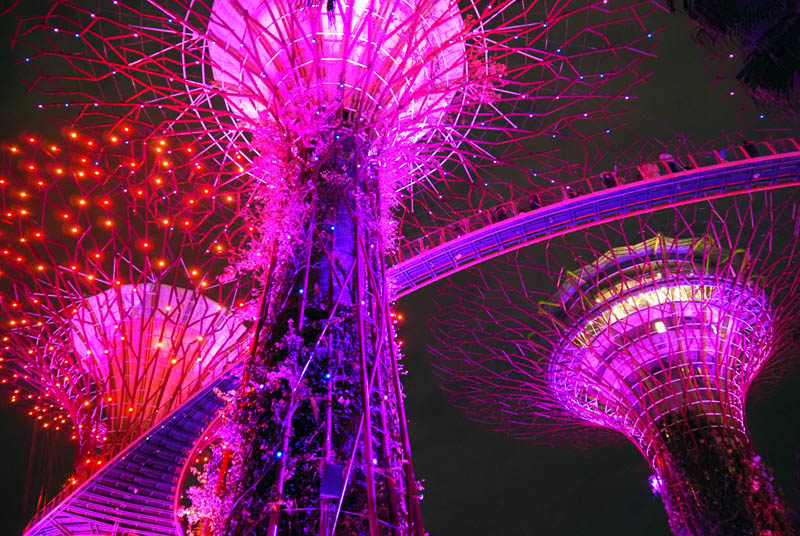
Singapore - Supertrees
After the performance ended, we walked back across Marina Bay towards the waterfront promenade in front of Marina Bay Sands to watch Spectra, the resort's nightly multimedia show. Presented over the waters of the bay, Spectra combines fountains, lasers, water projections, coloured lighting, and an original musical soundtrack into a performance lasting approximately fifteen minutes. The show is projected from floating platforms installed in the bay, while Marina Bay Sands itself provides the illuminated backdrop. Large crowds gather along the promenade each evening, although the wide viewing areas allow spectators to spread out around the waterfront. From this location, we were also able to observe the illuminated skyline of Singapore's financial district reflected across Marina Bay, completing another circuit of the city's principal waterfront landmarks.
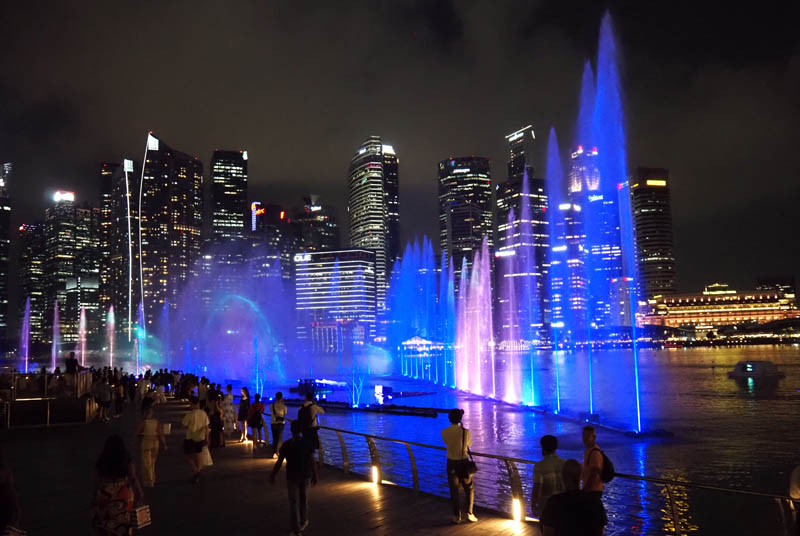
Marina Bay - Spectra (Light and Water Show)
To conclude our final evening in Singapore, we walked along the Singapore River to Boat Quay, one of the city's oldest commercial districts. During the nineteenth century, this stretch of the river formed the centre of Singapore's trading activities, with warehouses and godowns lining the waterfront where goods arriving by boat were loaded and unloaded. Today, the restored riverside shophouses have been converted into restaurants, cafés, and bars while preserving their historic façades. We chose one of the riverside restaurants for dinner, with views across the river towards the illuminated skyline and nearby bridges. After finishing our meal, we made our way back to the MRT and eventually returned to our hotel to sleep before going to Changi Airport next morning.